
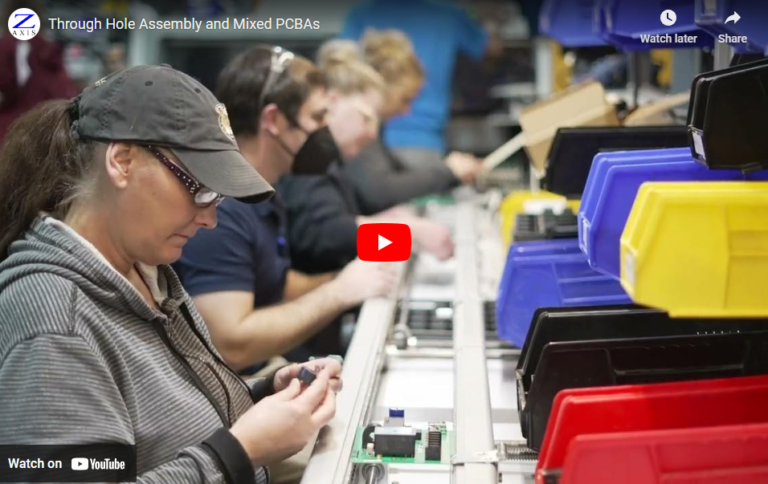
What is a Through Hole PCB Assembly Service?
Through Hole PCB Assembly remains a critical manufacturing method for products that require maximum mechanical strength, high current capacity, and long‑term durability. While SMT dominates compact electronics, through‑hole assembly is still the gold standard for mission‑critical applications exposed to vibration, shock, heat, or field maintenance.
A professional Through Hole PCB Assembly service handles the full process: component preparation, manual or automated insertion, wave soldering, selective soldering, and final inspection. This ensures that connectors, transformers, relays, large capacitors, and other high‑power components are anchored securely to the board. The result is a robust electrical and mechanical connection that outperforms surface‑mount alternatives in harsh environments.
Industries such as industrial controls, automotive, aerospace, defense, transportation, and power electronics rely heavily on through‑hole construction. A strong service provider not only assembles boards but also offers DFM support, mixed‑technology integration, and 100% inspection for solder joints and lead integrity.
For OEMs, choosing the right Through Hole PCB Assembly partner means fewer field failures, easier serviceability, and a more reliable product lifecycle. Whether you need prototypes, low‑volume builds, or high‑reliability production runs, through‑hole assembly delivers the rugged performance your application demands.
Frequently Asked Questions
What is Through Hole PCB Assembly?
Through Hole PCB Assembly is a process where component leads are inserted into drilled holes on a printed circuit board and soldered for strong mechanical and electrical connections.
Why choose through‑hole assembly over SMT?
Through‑hole components provide superior durability, higher current capacity, and better resistance to vibration, shock, and heat—making them ideal for rugged or mission‑critical applications.
What types of components require through‑hole assembly?
Common THT components include connectors, transformers, relays, large capacitors, inductors, switches, and high‑power semiconductors that need strong anchoring to the PCB.
Which industries rely on through‑hole PCB assembly services?
Industries such as industrial controls, automotive, aerospace, defense, transportation, power electronics, and heavy equipment depend on THT for long‑term reliability.
What soldering methods are used in through‑hole assembly?
Depending on volume and design, manufacturers use wave soldering, selective soldering, or hand soldering to achieve consistent, high‑quality joints.
Can through‑hole and surface‑mount components be used together?
Yes. Many PCBs use mixed‑technology assembly, combining SMT for compact circuitry with THT for high‑strength or high‑power components.
Are through‑hole boards easier to repair?
Generally yes. THT components are larger and easier to desolder and replace, making them ideal for serviceable or field‑maintained products.
Does through‑hole assembly increase cost?
THT can be more labor‑intensive than SMT, but it often reduces long‑term costs by improving durability and reducing field failures.
What quality checks are performed during THT assembly?
Quality steps may include visual inspection, X‑ray for hidden joints, continuity testing, and verification of solder integrity and lead placement.
When should I choose a through‑hole PCB assembly service?
Choose THT when your design requires mechanical strength, high current handling, thermal stability, or long‑term reliability in demanding environments.